


You do not need to become an SEO expert, an AI expert, or add three entirely separate marketing strategies to your already-too-long to-do list.
Search is changing, but the reason people search hasn’t.
They’re still looking for answers, services, recommendations and businesses they can trust.
What’s changing is where they search and how they ask.
Someone might type “coach website designer Ottawa” into Google.
They might search “What pages should I have on my coaching website?”
Or they might open ChatGPT and ask “I’m a business coach in Ottawa. What should my website include and how do I find someone to design it?”
That’s where SEO, AEO and GEO come in.
And despite the impressive collection of acronyms, they’re much more connected than they sound.
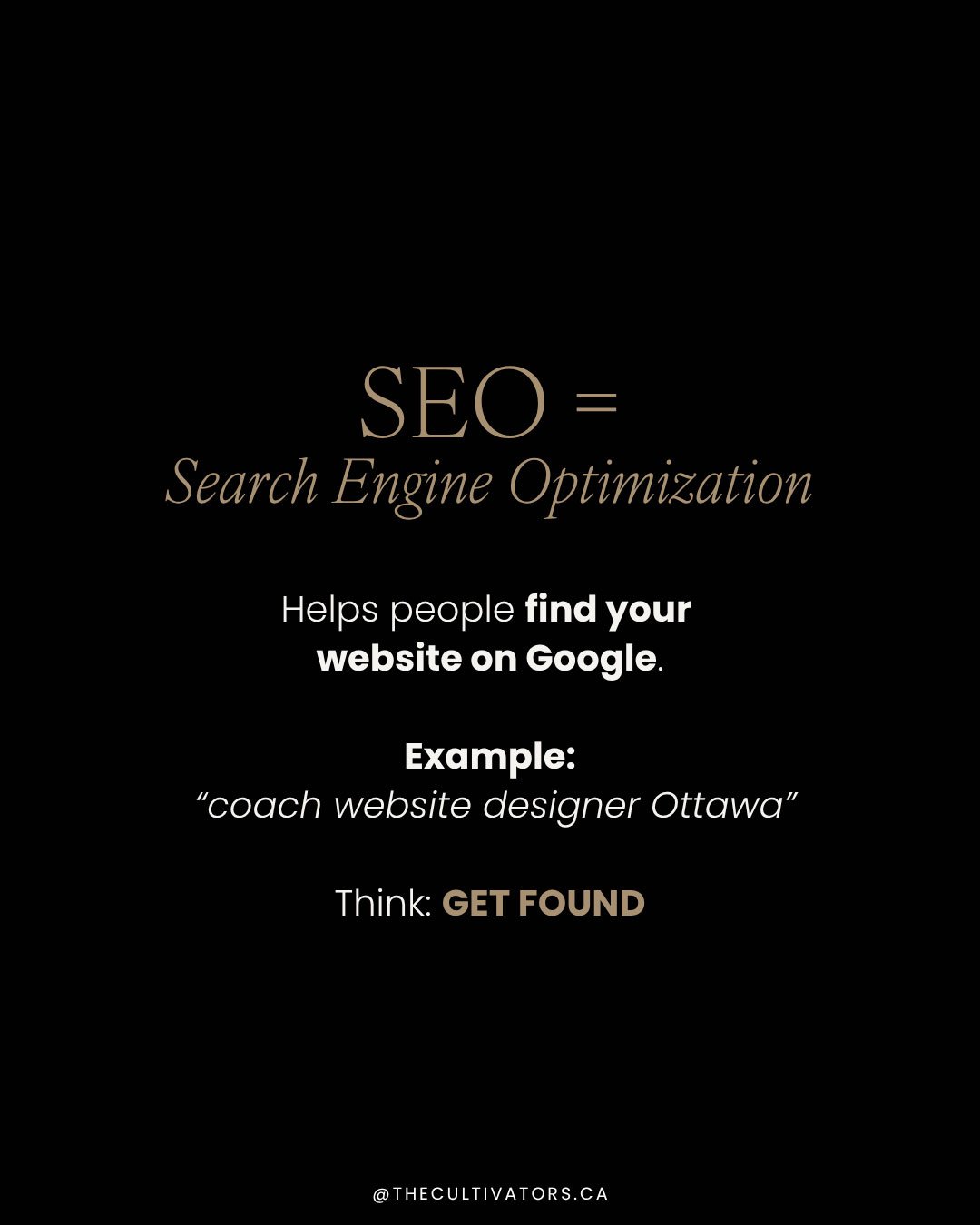
What Is SEO?
SEO stands for Search Engine Optimization.
It’s the process of making your website easier for search engines like Google to find, understand and rank when someone searches for something related to your business.
For example, someone might search:
“coach website designer Ottawa”
If you’re a website designer who works with coaches in Ottawa, you’d ideally want your website to appear somewhere in those results.
SEO can include things like:
- Creating individual pages for your services
- Using descriptive page titles and headings
- Writing useful content around topics your clients search for
- Optimizing your website’s structure and URLs
- Improving page speed and mobile usability
- Building your authority and credibility online
- Local SEO for businesses serving a particular area
But SEO isn’t about cramming the same keyword into a page 37 times and hoping Google gets the hint.
A good SEO strategy starts with understanding what your ideal clients are actually searching for and creating genuinely useful pages around those searches.
SEO in simple terms:
SEO helps the right people find your website when they’re searching.
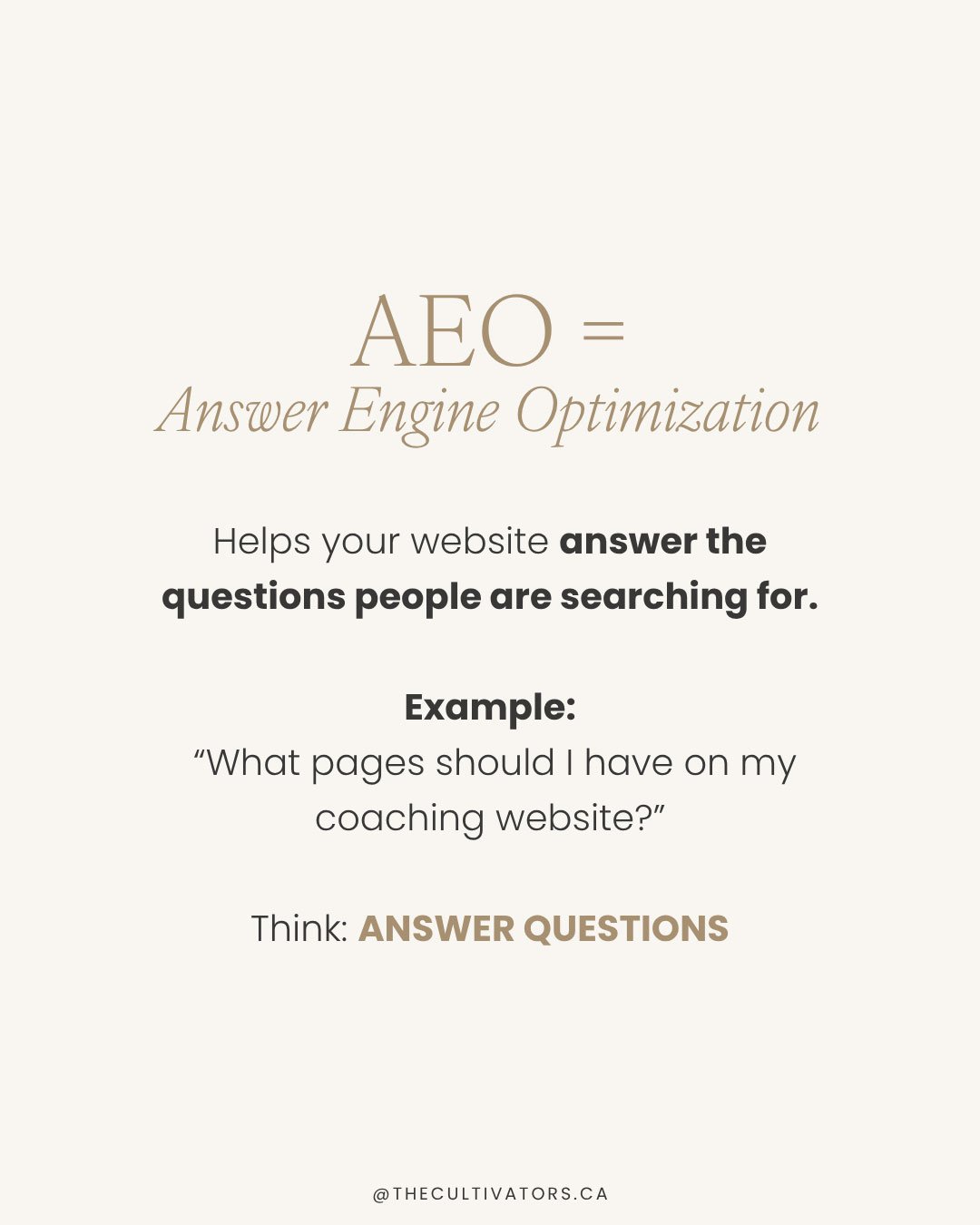
What Is AEO?
AEO stands for Answer Engine Optimization.
Instead of only thinking about what someone might type into a search bar, AEO considers the questions they’re asking.
For example:
“What pages should I have on my coaching website?”
That’s a much more specific question than “coach website design.”
If I have an article on my website that clearly explains what pages a coaching website should include, I’ve created content that directly addresses that question.
That’s the idea behind AEO.
Search engines increasingly try to give people useful answers, not simply a list of websites to click.
So your website should contain content that actually answers the questions your ideal clients have.
That might include:
- Frequently asked questions
- Educational blog posts
- How-to articles
- Comparison articles
- Service pages that answer common questions
- Clear definitions and explanations
- Helpful, specific answers rather than vague marketing copy
And chances are, you already know what many of those questions are.
Think about what clients ask you during discovery calls, consultations, emails or appointments.
Those questions can become incredibly useful website content.
AEO in simple terms:
AEO helps your website provide the answer someone is looking for.
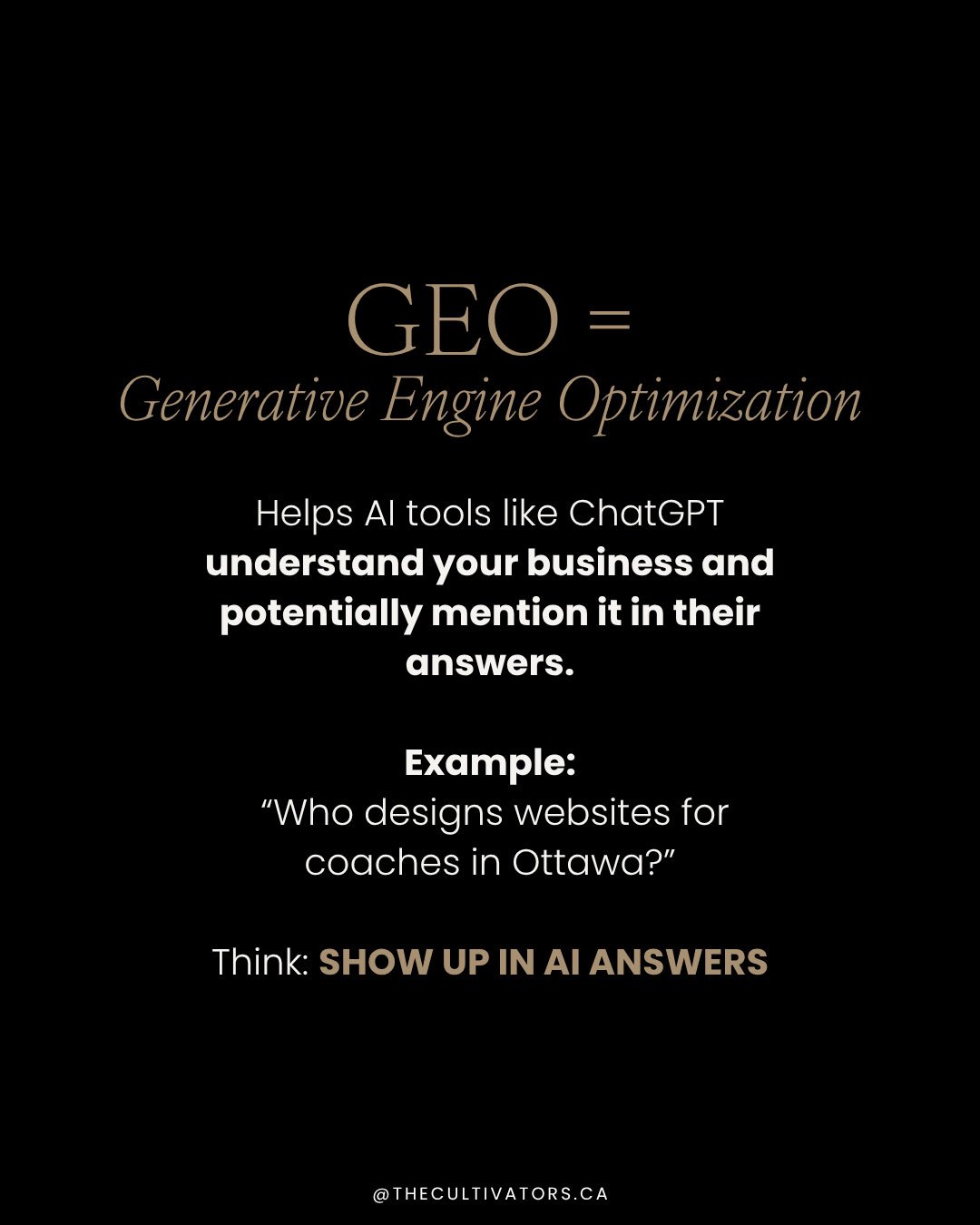
What Is GEO?
Here’s the newer acronym.
GEO stands for Generative Engine Optimization.
It refers to optimizing your online presence so generative AI systems and AI-powered search experiences can better understand your business, expertise and content and potentially use or reference that information when generating an answer.
Instead of searching Google for:
“coach website designer Ottawa”
someone might ask an AI tool:
“Who designs WordPress websites for coaches in Ottawa?”
Or:
“I’m starting a coaching business. What should my website include?”
Rather than simply returning ten blue links, generative AI can create a response based on information it has access to.
For businesses, that introduces a new consideration:
Can these systems clearly understand who you are, what you do, who you help and what you know about?
That’s one reason having clear, useful and specific content on your own website is becoming increasingly important.
GEO in simple terms:
GEO helps AI systems better understand your business and expertise, increasing the possibility that your content or business may be surfaced in relevant AI-generated answers.
Notice I said possibility.
There is no magic setting that guarantees ChatGPT, Google or another AI platform will recommend your business. Anyone promising guaranteed placement in AI answers deserves a healthy amount of side-eye.
What’s the Difference Between SEO, AEO and GEO?
Here’s the easiest way to remember it:
| What it helps with | Example | |
|---|---|---|
| SEO | Getting found in search | “coach website designer Ottawa” |
| AEO | Answering specific questions | “What pages should I have on my coaching website?” |
| GEO | Being understood and potentially surfaced by AI | “Who designs websites for coaches in Ottawa?” |
They’re different, but they aren’t completely separate strategies.
In fact, there’s a lot of overlap.
Do I Still Need SEO in 2026?
Yes. Absolutely.
AI search hasn’t suddenly made Google or traditional SEO irrelevant.
Instead, we’re seeing the ways people find information expand.
Someone might discover your business through a traditional Google search, a Google Business Profile, an AI-generated search result, ChatGPT, a recommendation, social media, or several of those things before they ever contact you.
That’s why I wouldn’t abandon SEO to chase whatever the newest acronym happens to be.
I’d build a website with a strong SEO foundation and structure the content so it’s easy for humans, search engines and AI systems to understand.
That’s a much more sustainable strategy.
How Do You Optimize a Website for SEO, AEO and GEO?
Here’s where things become much less intimidating.
You don’t need three versions of your website.
Many of the fundamentals overlap.
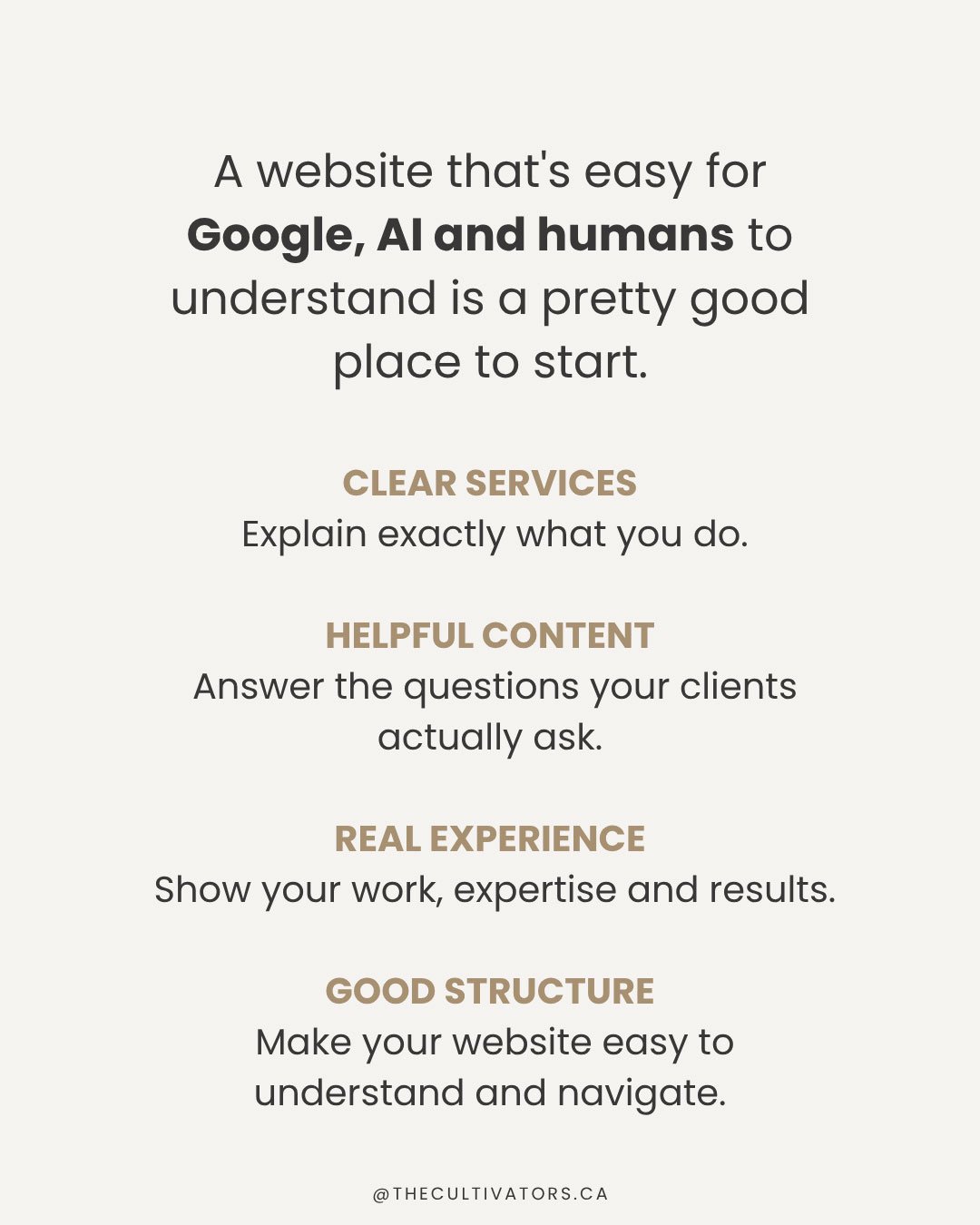
1. Clearly explain what you do
Within a few seconds of landing on your website, someone should be able to understand:
- What do you offer?
- Who is it for?
- Where do you offer it?
- Why should someone choose you?
Clear beats clever when your website needs to be understood by humans and machines.
You can still have personality. Just don’t make someone solve a riddle to figure out what your business actually does.
2. Create a page for each important service
One generic Services page isn’t always enough.
If you offer several distinct services, dedicated pages give you more room to explain each one properly.
For example, my website doesn’t simply say “I design things.”
I can have dedicated information about website design, branding, website reviews and the specific industries I work with.
That creates clearer context for visitors while giving search engines and AI systems more information about what my business actually offers.
3. Answer the questions your clients are already asking
This is one of the simplest ways to improve your content.
If you’re constantly answering the same question in emails or discovery calls, there’s a good chance other people are searching for it too.
For a coach, that might be:
- What pages should a coaching website have?
- Should a coach have pricing on their website?
- Do I need a blog?
- What should I put on my About page?
- Should I use WordPress, Squarespace or Wix?
- How much does a professional coaching website cost?
These questions can become FAQs, sections within service pages or entire blog posts.
You’re not creating content for an algorithm.
You’re answering real questions from real potential clients.
That’s useful whether the reader finds you through Google or an AI tool.
4. Show real experience
Don’t just tell people you’re an expert.
Show them.
Case studies, portfolio projects, testimonials, reviews, client results, original photographs, detailed About pages and examples of your work all help establish who you are and what you’ve actually done.
If you’re a contractor, show completed renovations.
If you’re an interior designer, show full project galleries.
If you’re a therapist, clearly explain your areas of focus and approach.
If you’re a consultant, share insights based on the work you actually do.
Generic content is incredibly easy to create now.
Real experience isn’t.
And that’s becoming an increasingly important differentiator.
5. Create genuinely helpful content
You don’t need to publish a blog post every Tuesday because someone on Instagram told you Google likes fresh content.
I’d rather see a business publish 10 genuinely useful articles than 100 posts written purely to target keywords.
Think about the questions people ask before hiring you.
Then answer them thoroughly.
A potential client may discover one of those articles months before they’re ready to work with you.
When the time comes to hire someone, you’ve already demonstrated that you understand their problem.
6. Make your website easy to understand
Good website structure isn’t just a design decision.
Your navigation, headings, page hierarchy, internal links and content structure all help establish relationships between the information on your website.
For example:
Industries → Coaches & Consultants → Coaching Website Resources
creates context.
So do descriptive headings such as:
What Pages Should a Coaching Website Have?
That’s much more useful than a vague heading like:
Everything You Need to Succeed
Cute? Maybe.
Helpful to someone scanning the page? Not particularly.
7. Don’t forget the technical foundations
Great content sitting on a technically messy website can only do so much.
Your website should also have solid foundations, including:
- Mobile-responsive design
- Fast loading times
- HTTPS/security
- Logical URLs
- XML sitemap
- Search engine indexing
- Proper heading structure
- Descriptive image alt text where appropriate
- Internal linking
- Structured data where relevant
- No major crawl or indexing issues
You don’t need to personally understand every technical detail.
You just need someone building your website who does.
Is GEO Replacing SEO?
No.
A better way to think about it is that search is expanding.
Traditional search engines aren’t disappearing, but people now have more ways to find information.
And that’s why I don’t think businesses should build an entire strategy around trying to “game” AI search.
- Build a strong website.
- Make it technically sound.
- Clearly explain what you do.
- Publish useful information.
- Demonstrate real experience.
- Answer your clients’ questions.
- Make your business easy to understand.
Those fundamentals support traditional SEO while also making your content more useful for answer-based and AI-driven search.
What Should Small Businesses Focus on First?
If all of this still sounds like another thing you’re supposed to add to your plate, start here:
Make your website genuinely useful to the person you’re trying to attract.
- Can they immediately understand what you do?
- Can they find your services?
- Can they see examples of your work?
- Can they find answers to their questions?
- Can they tell where you’re located or who you serve?
- Can they understand why they should trust you?
- Can they easily take the next step?
If the answer to those questions is yes, you’re already creating the kind of website that works better for people, search engines and AI.
SEO, AEO and GEO: The Bottom Line
The terminology might be changing, but good website strategy hasn’t suddenly been thrown out the window.
SEO helps you get found.
AEO helps you answer questions.
GEO helps AI understand and potentially surface your business and expertise.
And all three benefit from the same fundamental idea:
Create a clear, trustworthy, useful website for the people you’re actually trying to reach.
Search will continue to change.
Your job isn’t to chase every algorithm update or new acronym.
Your job is to make sure that wherever your ideal client is searching, your business is as easy as possible to find, understand and trust.
And if you’d rather focus on running your business than figuring out SEO, AEO, GEO and whatever acronym comes next, that’s exactly where I come in.
Browse The Post